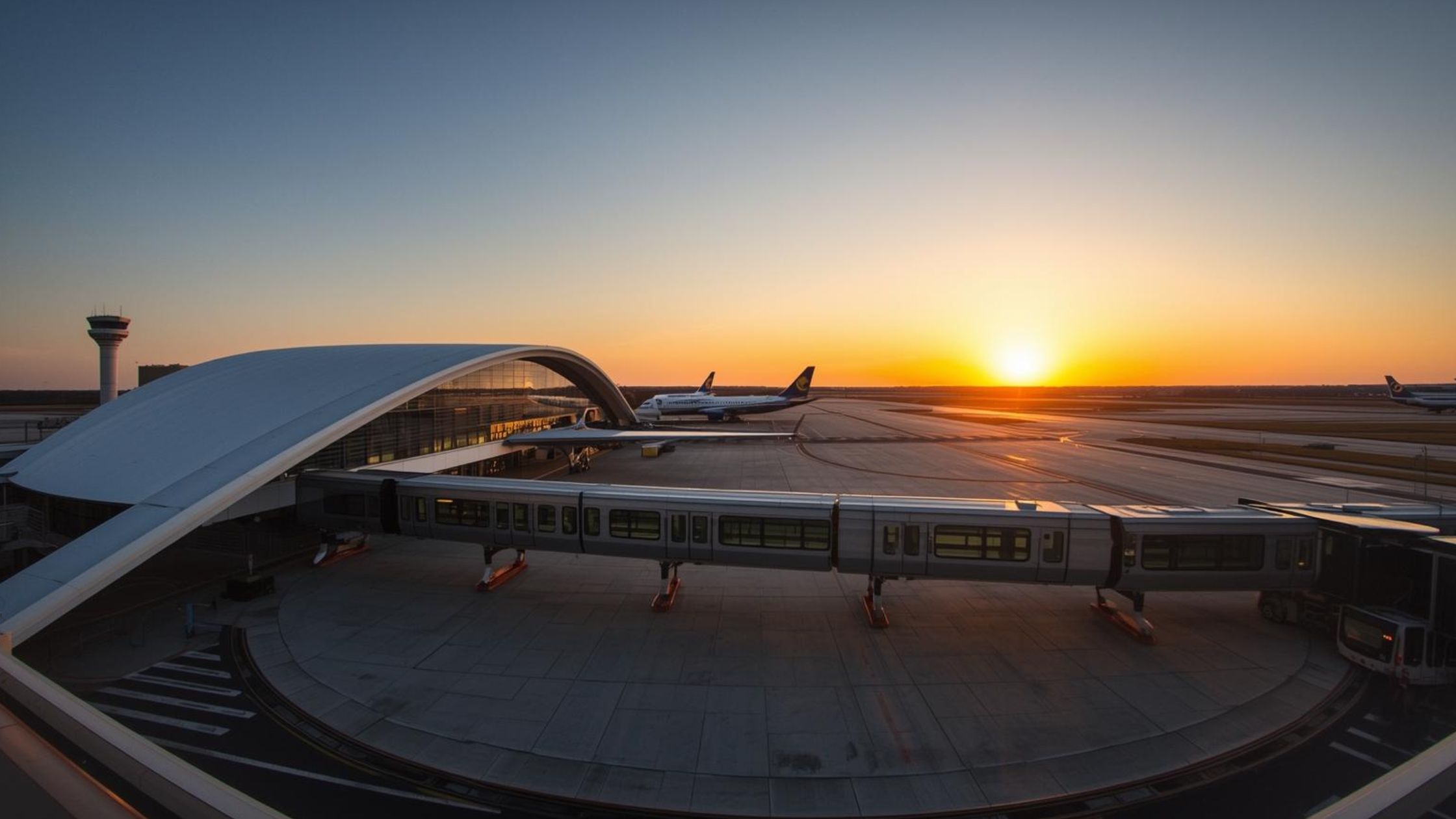
Dulles International Airport: Why This Airport Matters So Much
When people talk about “flying into Washington DC,” they usually mean one of three airports: DCA, BWI or IAD. Among them, Washington Dulles International Airport (IAD) stands apart. It is the region’s primary long-haul international gateway, a major hub in global airline networks, and a powerful magnet for investment across Northern Virginia.
This article looks at why Dulles matters – historically, architecturally, economically and strategically – and why its role in the region will only grow in the coming years.
1. A Purpose-Built Gateway for the U.S. Capital
Unlike many airports that grew out of old airfields, Dulles was conceived from the start as a purpose-built international gateway for the nation’s capital.
• It opened in the early 1960s, at a time when jet travel was reshaping how people crossed continents.
• The federal government chose a large site in what is now Loudoun and Fairfax Counties in Virginia, far enough from downtown to allow long runways, future expansion and minimal noise impact on the city.
• From the beginning, the airport was designed to serve not only Washington DC, but also Northern Virginia and parts of Maryland – a broader capital region rather than a single city.
The result was a bold, ambitious project that went beyond “just another airport.” Dulles was intended to showcase the United States as a modern, outward-looking country with a direct connection to the rest of the world.
2. Eero Saarinen’s Iconic Architecture and Design Legacy
One of the reasons Dulles is so recognizable is its main terminal building, designed by the Finnish-American architect Eero Saarinen, who also designed the TWA Flight Center at JFK and the Gateway Arch in St. Louis.
2.1 The Signature Roof
The main terminal’s sweeping concrete roof, held up by a line of angled columns, is not just a visual flourish:
• It gives the building a sense of motion, echoing the idea of flight.
• The long, open hall inside can handle large passenger flows without feeling cramped.
• The design has aged remarkably well; today it is seen as a classic of mid-century modern architecture.
For many travelers, that first view of the terminal as the car approaches the curb – the roof hovering above the glass walls – is an unforgettable “you have arrived in Washington” moment.
2.2 Mobile Lounges and the Idea of a Futuristic Airport
Dulles also became known for its mobile lounges or “people movers” – large vehicles that bring passengers from the main terminal to the midfield concourses.
• When they were introduced, they were meant to spare passengers from long walks and give them a futuristic, almost space-age experience.
• Over time, most large airports moved to trains and fixed concourses, but Dulles retained its people movers even as it added the AeroTrain system and expanded its concourses.
• Today they are part of the airport’s character: some see them as nostalgic relics, others as charming design icons that remind travelers of Dulles’ pioneering past.
Whether you love or hate them, the combination of Saarinen’s terminal and the people movers has made Dulles one of the most visually distinctive airports in the world.
3. A Major Hub in the Global Air Network
Dulles isn’t just pretty to look at – it is a busy, high-capacity hub that connects the capital region to destinations around the globe.
3.1 International Reach
Dulles consistently ranks among the top U.S. airports for international passengers. Long-haul flights from IAD typically include:
• Major European capitals (London, Paris, Frankfurt, Rome and more)
• Key Middle Eastern and North African cities
• Transatlantic leisure destinations such as the Mediterranean and parts of the French and Italian coasts
• Important business and diplomatic routes linked to international organizations and embassies in Washington DC
Because Washington is the seat of the U.S. federal government, airlines see Dulles as a natural gateway for:
• Diplomats and government officials
• International business travelers
• Employees of NGOs, think tanks and global institutions
3.2 Hub for United Airlines and Partners
Dulles serves as a core hub for United Airlines and its regional partners. This has several consequences:
• A large percentage of passengers use Dulles to connect between domestic and international flights.
• United and alliance partners offer dense schedules on core routes, making it easier for travelers to find flights that match their schedules.
• The hub structure supports routes that might not survive on local demand alone; connecting traffic helps make them viable.
As a result, Dulles offers a wide menu of destinations compared with other airports in the region, especially when it comes to long-haul flights.
4. Economic Engine for Northern Virginia and the Capital Region
Airports of this size are never just transportation facilities; they are economic ecosystems.
4.1 Jobs and Local Business
Dulles directly and indirectly supports:
• Tens of thousands of jobs in aviation, security, hospitality, retail and cargo
• A whole network of hotels, conference centers and restaurants that cater to overnight and transit passengers
• Specialized service providers: maintenance companies, ground handling, logistics operators, technology vendors and more
For many companies, locating in the Dulles corridor is a strategic move: employees and clients can fly in and out with minimal friction.
4.2 Catalyst for Technology and Data Centers
Northern Virginia has become one of the world’s most important data center clusters, and proximity to a major global airport strengthens the area’s appeal:
• Tech companies can move staff and hardware quickly.
• International clients can reach their providers through a single nonstop flight plus a short ground transfer.
• The airport’s cargo capabilities also support the movement of high-value equipment and time-sensitive shipments.
All of this helps make the broader Washington–Northern Virginia region more attractive for technology, defense, consulting and international organizations.
5. Ground Access: Silver Line, Highways and Private Transfers
A global hub is only as good as its ground connectivity, and Dulles has steadily improved in this area.
5.1 Metro’s Silver Line
The extension of the Silver Line of the Washington Metro out to Dulles created a direct rail link between the airport and:
• Downtown Washington DC
• Tysons and Reston business districts
• Suburban residential areas in Fairfax and Loudoun Counties
This connection makes Dulles more attractive for both residents and visitors, especially those who prefer public transit over driving.
5.2 Highway and Road Access
Dulles is served by:
• The Dulles Access Road, which offers limited-access, direct highway connections from the airport to the Beltway.
• The Dulles Toll Road and Route 28, tying the airport into a wider regional highway network.
• A growing ring of office parks, industrial areas and residential neighborhoods.
For business travelers, this means they can land at Dulles and be in a Tysons or Reston meeting room within a relatively short drive.
5.3 Private Shuttle and VIP Ground Transportation
Beyond public transit and standard taxis, Dulles is supported by a robust ecosystem of private ground transportation services:
• Pre-booked sedans and SUVs
• Sprinter vans for small groups and corporate teams
• Chauffeured services that track flight times and adjust pickup according to actual arrival
For travelers who want a seamless experience, private shuttle and black car services like
our VIP airport transfer service connect Dulles directly to hotels, corporate offices and homes across Washington DC, Northern Virginia and Maryland. Door-to-door service transforms the airport from a distant point on the map into a convenient starting or ending point for any trip.
6. Dulles vs. DCA and BWI: Complementary Roles
The Washington region’s three major airports each have a distinct role:
• DCA (Reagan National): Close to downtown, focused on domestic and short-haul flights, with strict perimeter rules and slot limitations.
• BWI (Baltimore/Washington International): Strong low-cost carrier presence, serving both Baltimore and the DC area, with significant domestic and some international operations.
• IAD (Dulles): The primary global gateway, handling the majority of the region’s intercontinental traffic and a large share of domestic connections.
Because of:
• Its long runways
• Ability to handle widebody and very large aircraft
• Availability of slots and gate space
Dulles is uniquely positioned for new long-haul services and expanded global connectivity that would be difficult to accommodate at DCA.
For airlines planning new routes to the capital region – especially from Europe, the Middle East, Africa and Asia – Dulles is usually the natural first choice.
7. Modernization and Future Growth
Airports must keep evolving, and Dulles is in the middle of a multi-year modernization wave.
Key elements include:
• New concourses and gate expansions designed to replace older facilities and improve the passenger experience.
• Enhanced AeroTrain connectivity, reducing dependence on mobile lounges for many gates.
• Ongoing upgrades to check-in areas, security checkpoints and baggage systems, designed to handle higher passenger volumes more smoothly.
• New and updated lounges, restaurants and retail offerings, many of them reflecting local DC and Virginia brands.
Airlines are responding to this improved infrastructure with:
• Additional international routes to emerging markets and leisure destinations.
• More frequencies on core business routes.
• Investments in training centers and operations bases in the Dulles area.
Taken together, these developments indicate that the industry sees Dulles as a long-term strategic hub, not a temporary focus.
8. Why Dulles Will Keep Growing in Importance
Looking ahead, several trends suggest that Dulles’ importance will continue to grow:
1. Globalization of government and diplomacy
Washington DC remains a central stage for international negotiations, summits and policy work. Dulles, as the main long-haul gateway, is the natural entry point for many of those trips.
2. Expansion of Northern Virginia’s tech and data center sector
As more cloud providers, cybersecurity firms and data-intensive businesses cluster around the Dulles corridor, the value of fast, direct air links to Europe, the Middle East, Africa and Asia will only increase.
3. Improved ground connectivity
The Silver Line, ongoing road improvements and a mature ecosystem of private transportation providers make the airport increasingly easy to reach for both residents and visitors.
4. Available space for future expansion
Unlike airports that are locked in by dense urban development, Dulles has room to adjust, modernize and expand its facilities to meet future demand.
9. What Dulles Represents for the Region
In the end, Dulles is much more than a place where planes land and take off. It represents:
• A physical bridge between the U.S. capital and the rest of the world
• A symbol of modern design, thanks to its Saarinen-designed terminal and unique people-moving systems
• A driver of growth and opportunity, supporting jobs, business travel, tourism and investment
• A strategic asset, giving Washington DC, Northern Virginia and Maryland a powerful tool for staying connected to global markets and institutions
For leisure travelers, it might simply be the starting point of a long-planned vacation. For business travelers, it is a vital link in global supply chains and deal-making. For the region as a whole, Dulles is a core part of its identity: a world-facing gateway that helps Washington DC function as a truly international capital.
And as global travel patterns continue to evolve, Washington Dulles International Airport (IAD) is positioned not just to keep up, but to remain one of the most important and recognizable hubs in the United States.
Enjoy your trip with MovL