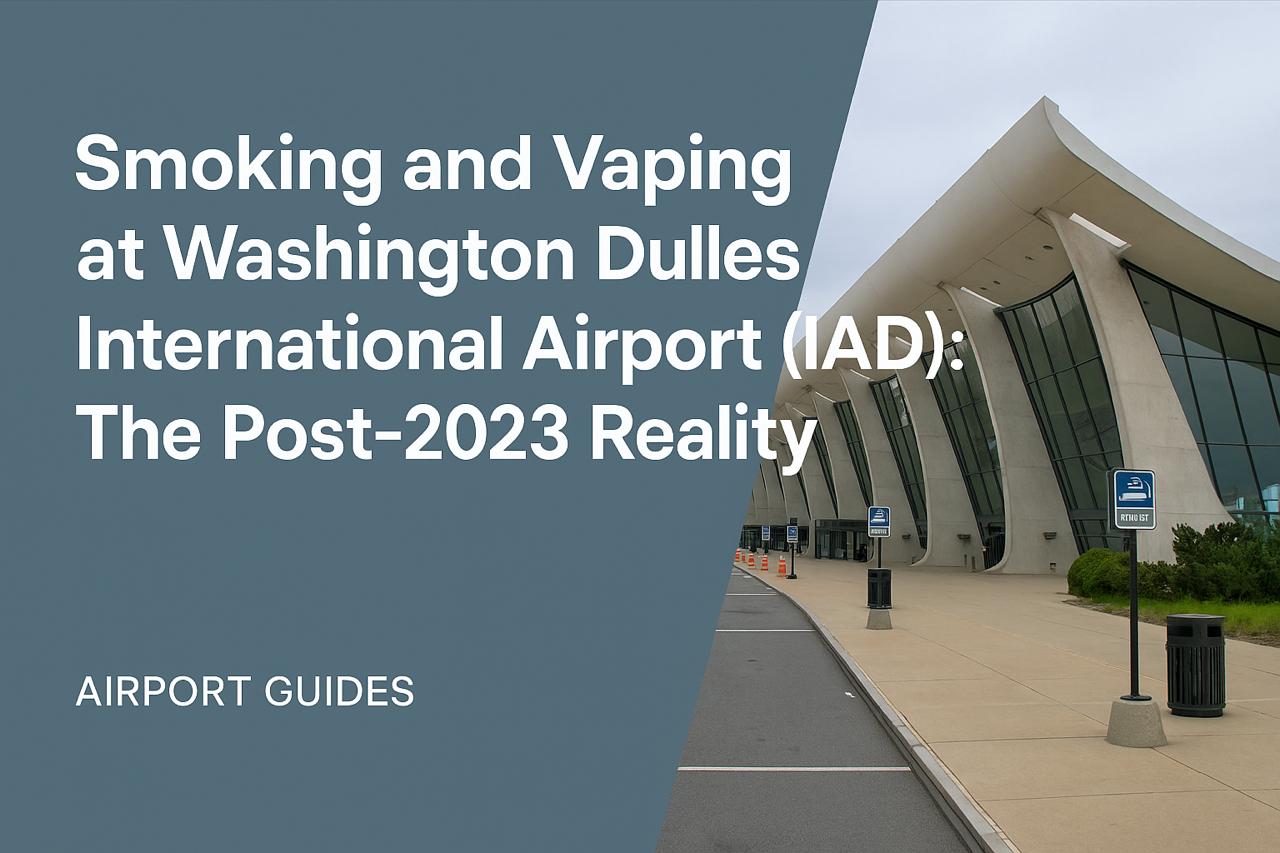
Smoking and Vaping at Washington Dulles International Airport (IAD): The Post-2023 Reality
Washington Dulles International Airport (IAD) serves as one of the primary international gateways to the United States capital region. Over time, its approach to smoking and vaping has shifted from indoor lounges and smoking rooms to a modern, smoke-free terminal model that aligns with broader public-health trends in US airports.
This guide focuses on what the rules look like after 2023, how they affect travelers who smoke or vape, and how these regulations intersect with the overall airport experience and ground transportation options.
1. From Smoking Lounges to a Smoke-Free Terminal
For many years, Dulles Airport was known among smokers and vapers for its dedicated indoor smoking rooms in the concourses. That era is now over.
• The terminal and concourses operate as 100% smoke-free indoor spaces.
• Cigarettes, cigars, pipes, e-cigarettes, heated tobacco products and other electronic smoking devices are treated under the same general “no smoking indoors” approach.
• The policy aligns Dulles with the direction taken by most major US hubs, where the terminal interior is treated as a single smoke-free environment.
Smoking inside the terminal, in restrooms, in boarding areas, in jet bridges, in lounges or inside any other indoor section of the building is prohibited under current rules.
2. The 2023 Turning Point: Closure of Indoor Smoking Lounges
The key shift at Dulles came in June 2023, when the airport’s smoking lounges were officially phased out and closed.
Before this change, passengers in the midfield concourses could step into enclosed rooms to smoke or vape between flights. With the updated policy:
• Those indoor rooms ceased operating as designated smoking spaces.
• The airport’s public information now reflects an indoor environment where smoking is not accommodated beyond security.
• Travelers on long international itineraries no longer find an indoor option between flights.
This move brought Dulles in line with other airports that had already removed similar lounges years earlier, consolidating the airport’s image as a modern, smoke-free facility.
3. Where Smoking Is Still Allowed at Dulles (IAD)
Although the inside of the terminal is now smoke-free, smoking has not disappeared entirely from the airport grounds. Like many large airports in the United States, Dulles still accommodates smokers in designated outdoor areas.
Key points about outdoor smoking at IAD include:
• Smoking is permitted only in specific outdoor spots located away from the main doors of the terminal.
• These areas are generally positioned along the curbsides and exterior walkways, and are typically marked with signs and ashtrays or receptacles.
• The intent is to separate smoke from the heavy pedestrian flow near entrances and exits, and from the air intakes that serve the terminal.
Local and regional smoke-free regulations influence how close smoking can be to doors, windows and ventilation points. In practice, this means that smoking tends to be pushed outward from the building façade toward clearly marked areas rather than scattered randomly along the curb.
Inside the building, including just beyond the sliding doors, the assumption is simple: the environment is treated as non-smoking.
4. Vaping and E-Cigarettes in the Airport Environment
Vaping devices and e-cigarettes occupy a hybrid space between technology and tobacco, and US regulations have gradually settled on a common approach in airports and on aircraft.
Use in the terminal
• Electronic smoking devices are covered by the same indoor rules as traditional cigarettes.
• Using e-cigarettes, heated tobacco devices or other vaporizers inside the terminal is treated as a violation of the airport’s smoke-free policy.
Carriage on the aircraft
• Transportation Security Administration (TSA) rules distinguish between carrying a device and using it.
• Current federal security guidance treats electronic smoking devices as items that travel in carry-on baggage, not in checked bags, due to the lithium batteries and fire-risk considerations.
• Using any smoking device on board an aircraft is prohibited under federal aviation regulations, regardless of whether it is traditional tobacco or an electronic vapor product.
Outdoor vaping
• Outdoors, the practical treatment of vaping generally mirrors that of smoking: it is limited to the same type of designated exterior spaces.
• Airports and local authorities usually avoid creating separate zones for vaping and smoking, preferring one set of rules that applies to both.
The overall pattern at Dulles is therefore straightforward: no use of vaping devices indoors or on the aircraft, and outdoor use only where smoking is already permitted.
5. How Regional Rules Shape the Policy at IAD
Dulles operates under the umbrella of regional regulations that govern indoor air quality, smoking restrictions and fire safety around public buildings. These rules influence:
• The decision to maintain a smoke-free interior across the terminal and concourses.
• The practice of placing smoking areas outside and at a distance from doors and air intakes.
• The consistent treatment of e-cigarettes and vaping as part of the same regulatory framework as traditional tobacco products.
As a result, the airport’s approach is not isolated or arbitrary; it reflects a broader trend in the Washington DC metropolitan area and across many large US airports that now function entirely smoke-free indoors.
6. Long Layovers and Connecting Flights at a Smoke-Free Airport
A smoke-free indoor terminal changes the experience of long layovers and tight connections, especially for passengers who smoke or vape.
Typical scenarios include:
• International–international connections: travelers who arrive from overseas and remain airside between flights pass through a terminal where no indoor smoking option is available. Any plans that previously depended on concourse lounges are now outdated.
• Arrivals who plan to smoke after landing: after leaving the aircraft, passengers move through immigration, baggage claim and the public arrivals hall. The first opportunity to smoke arises only after stepping outside to the designated curbside or outdoor locations.
• Departures and early arrivals at the airport: early check-in followed by time in the terminal now takes place in a fully non-smoking indoor environment. Any smoking that occurs before departure is limited to the outdoor areas near the terminal frontage before security.
The layout of Dulles—with its central main terminal and midfield concourses reached by train or people-mover—means that once travelers proceed through security and ride out to the concourses, the expectation is a single, continuous smoke-free environment until they return to the public side of the building.
7. Smoke-Free Ground Transportation and VIP Transfers
For many visitors, the airport transfer forms the bridge between a long flight and a stay in Washington DC, Northern Virginia or Maryland. Dulles is linked to the region by a mix of public transit, taxis, ride-share vehicles and private transfer services.
Within this ecosystem, premium shuttle and chauffeur services provide a controlled, comfortable environment from the terminal curb to hotels, offices or homes.
Our own service at movl.us focuses on:
• Pre-booked, point-to-point VIP transportation between IAD and key destinations in Washington DC, Arlington, Alexandria, Tysons, Reston and beyond.
• Professional drivers familiar with Dulles pick-up zones, traffic patterns on the Dulles Toll Road, and hotel clusters across the region.
• Vehicles prepared for airport work, including flight-tracking, luggage-friendly cargo space and smooth curbside coordination at departures and arrivals.
The same smoke-free logic that governs the terminal interior generally extends to quality ground transportation: vehicles are treated as clean, non-smoking environments, which supports the image of a premium airport-to-city journey.
8. Airline Rules, Federal Regulations and the Role of TSA
The airport’s internal policy interacts with several layers of oversight.
• Airport operator rules define what is allowed inside the building and on the terminal grounds.
• Airline policies regulate smoking and vaping on board, and often reiterate the federal prohibition during pre-flight announcements.
• Federal regulations set the framework enforced by the Federal Aviation Administration (FAA) and TSA, including the ban on in-flight smoking and the handling of lithium-battery devices such as e-cigarettes.
Taken together, these layers create a consistent pattern:
• No smoking or vaping in the terminal interior.
• No smoking or vaping on board any commercial flight.
• Careful handling of electronic smoking devices because of the battery technology involved.
9. Summary: The Current Smoking Landscape at Dulles (IAD)
The smoking and vaping landscape at Washington Dulles International Airport can be distilled into a few core points:
• Indoor smoking lounges are part of the past. The 2023 policy shift completed Dulles’s transition to a fully smoke-free interior.
• Smoking and vaping occur only in designated outdoor locations. These areas are positioned away from doors and air intakes around the terminal exterior and are typically marked with signage and receptacles.
• Vaping devices follow the same functional rules as cigarettes. They are not used indoors or on aircraft, and they are handled under battery-specific safety rules in aviation security procedures.
• The airport fits into a broader regional trend. Dulles aligns with other major airports in prioritizing smoke-free indoor air, while still carving out controlled outdoor spaces for smoking.
As global air travel continues to evolve, Washington Dulles International Airport stands as an example of a major hub that has moved decisively toward a smoke-free indoor environment, while maintaining clearly defined outdoor arrangements and integrating modern rules for electronic devices into the wider travel experience.
Use MovL for a premium experience